

Introduction
If you have more than one child, you will know this all too well
One minute they’re playing happily, and the next, it’s arguing, shouting, and
“Mum, she did this!”
As a mum of four girls, sibling disagreements are part of everyday life in my home.
There were times I felt like I was constantly stepping in, repeating myself, and trying to keep the peace.
It was exhausting.
But over time, I realised something important:
Sibling fighting isn’t the real problem, it’s how we respond to it that makes the biggest difference.
Children are still learning how to communicate, share, and manage their emotions.
And with the right approach, these moments can actually become opportunities to teach.
🟡 Key Takeaways
- Sibling fighting is normal
- Children need guidance, not control.
- Calm responses reduce conflict.
- Teaching skills works better than reacting
1. Don’t Rush to Take Sides
One of the biggest changes I made was stepping back before reacting.
Instead of asking:
👉 “Who started it?”
I now say:
👉 “Tell me what happened.”
This helps both children feel heard.
In many situations, both children are frustrated in different ways.
When children feel understood, they calm down faster, something I also noticed when dealing with tantrums in 👉 7 Positive Ways to Handle Toddler Tantrums Without Shouting.
2. Stay Calm (Even When It’s Loud)
I won’t pretend this is easy, because it isn’t.
But I’ve learned that when I raise my voice, everything escalates quickly.
When I stay calm, the situation settles faster.
Children mirror what they see.
👉 If we shout, they shout
👉 If we stay calm, they learn calmness
This is the same approach I talk about in 👉 Why Your Child Isn’t Listening (And What to Do Instead), our tone matters more than we think.
3. Teach Them How to Solve Problems
Instead of solving every argument, guide them.
You can ask simple questions like:
- “What can we do to fix this?”
- “How can we make it fair?”
At first, they may struggle, but over time, they begin to think for themselves.
In my experience, this builds confidence and reduces repeated arguments.
This also links closely to the ideas in 👉 10 Positive Discipline Techniques That Actually Work, where the focus is on teaching rather than punishing.
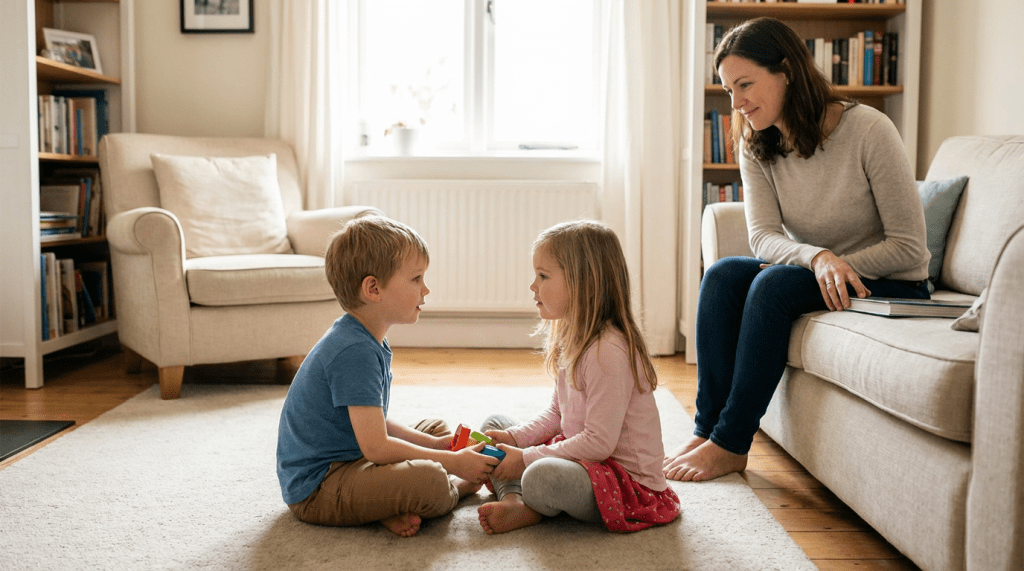
4. Set Clear and Calm Boundaries
Children need to know what is okay and what is not.
In my home, I calmly remind them:
👉 “It’s okay to feel upset, but we don’t hit.”
This helps them understand that emotions are allowed, but behaviour still has limits.
If your child struggles with big emotions, you might also find this helpful:
👉 5 Simple Ways to Help Children Manage Big Emotions
5. Give Them Space When Needed
Sometimes, the best thing you can do is create space.
Not as punishment, but as a way to calm down.
After a short break, it becomes easier to talk and resolve the issue.
This works especially well when emotions are high and no one is ready to listen.
6. Notice and Praise the Good Moments
With multiple children, it’s easy to focus on the fighting.
But I’ve learned to intentionally notice when things are going well:
- Playing nicely
- Sharing
- Helping each other
👉 “I love how you’re working together”
This reinforces the behaviour you want to see more of.
Why This Works (From My Experience)
From my background in teaching and working closely with children, I’ve seen that conflict is part of learning.
Children don’t automatically know how to handle disagreements, they learn through guidance.
At home, I have noticed that when I stay calm and consistent, arguments don’t disappear, but they become easier to manage.
And slowly, my children begin to handle situations better on their own.
Conclusion
Sibling fighting is a normal part of growing up.
It doesn’t mean something is wrong, it means your children are learning important life skills.
With patience, calm guidance, and consistency, these everyday moments can become opportunities to teach communication, respect, and understanding.
And over time, you’ll begin to notice:
- Less shouting
- Less stress
- More cooperation
💬 Final Thought
Next time your children argue, pause and ask:
👉 “What can they learn from this moment?”
Sometimes, the goal isn’t to stop the argument immediately, but to guide them through it.
 Smart Parent Guide
Leave a comment